TL;DR
- In neighborhood Facebook groups, local trade jobs often go to the first two or three useful commenters — not necessarily the "best" plumber, HVAC company, or electrician on paper.
- Urgent posts (burst pipe, no cool, dead outlets after a storm) move in minutes. Standard "who do you recommend?" threads still decide in the first hour more often than people admit.
- Scrolling between jobs is a lottery. Continuous alerts are how you show up early enough to win local trade jobs on Facebook without living in the app.
- GroupSignal watches your groups and emails you when someone asks for your service so you can reply while the thread is still open.
Why speed wins the job
Picture a homeowner who posts "anyone know a good plumber near [Town]? Water heater is leaking." They are not running a formal bid process. They want a trustworthy local answer before the evening gets worse. The first few people who reply with something useful — who they are, what town they cover, one clear next step — get the messages. Everyone else is writing into a thread the poster already stopped watching.
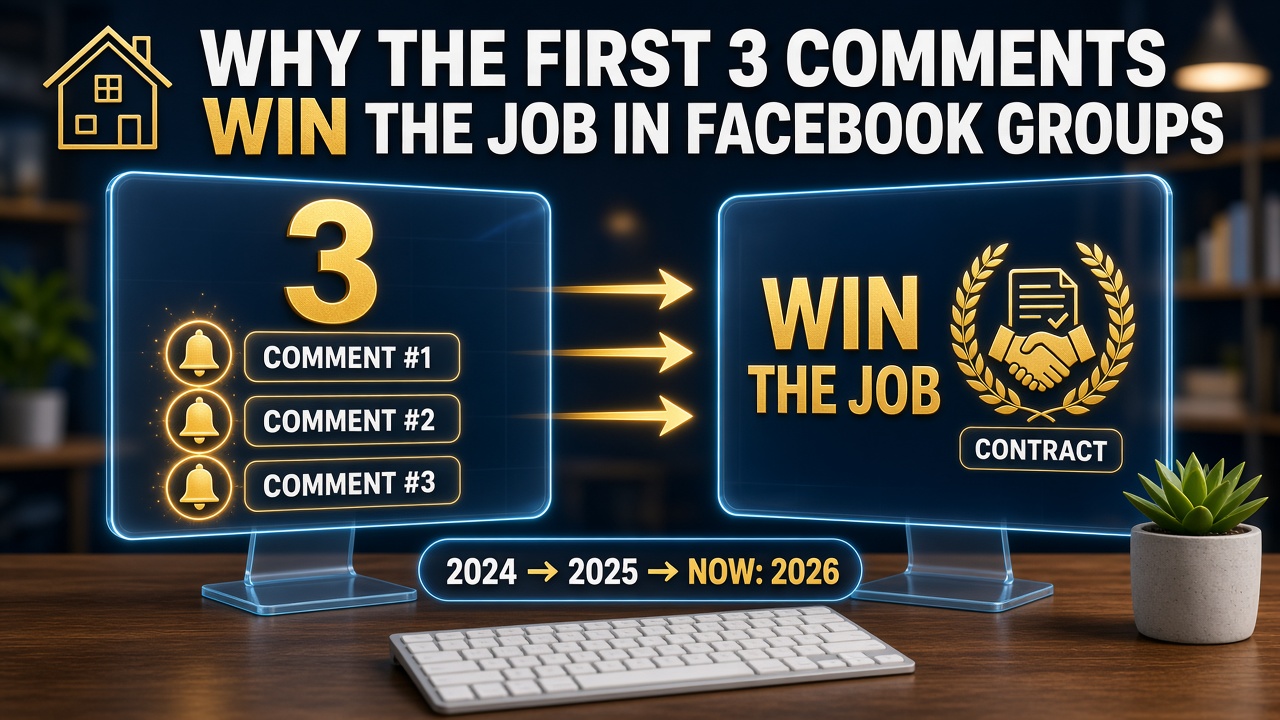
That is the first-3-comments rule in practice. Being first to reply in Facebook groups is not about gaming the algorithm. It is about matching how neighbors actually hire: skim the early replies, pick one that feels local and competent, and move on. Your license, reviews, and truck wrap still matter once you are on the call. They rarely get a chance if you never appear in that first wave.
This is also why "I'm the best company in town" does not automatically win the thread. The homeowner cannot see your Google rating from a buried comment. They see who showed up early, who sounded human, and who invited a message. Speed plus a clear, non-spammy reply is the combination that books the job.
Neighbor shout-outs still matter — "we used Bob last year, he was great" can beat a contractor comment. You cannot control that. What you can control is whether a competent local option is visible in the first screen of replies when the poster is still deciding who to text. If the only early comments are vague or from out-of-area accounts, a clean first reply from you often becomes the default choice. That is how ordinary shops win local trade jobs on Facebook against bigger brands: they are simply present when the ask is fresh.
Urgent vs standard response windows
Urgent: minutes, not "later today"
Burst pipes, sewage backups, AC dead in a heat wave, a panel that will not reset after a storm — these posts behave like inbound emergency calls. Neighbors pile on fast. The poster is often messaging someone within 15–30 minutes. If your first useful reply lands after the thread already has eight contractors and three neighbor shout-outs, you are late even if your offer is stronger.
On urgent threads, "I'll check Facebook after this job" is the same as missing the call. The homeowner is standing in water or a hot house. They hire the first person who sounds real and available, then stop reading.
Standard recommendation: aim for the first hour
"Who do you use for annual HVAC service?" or "recommend an electrician for a panel upgrade" moves slower than a flood, but not as slow as a Google search funnel. Useful replies still cluster early. By the afternoon, the poster has usually shortlisted two or three names from the first comments and stopped refreshing.
Planned work still rewards speed because Facebook groups are a convenience channel. The poster is collecting names, not building a spreadsheet of ten bids. Being in that short list is the whole game; being name #7 in a cold thread rarely converts.
What "late" actually costs
A late reply is not free marketing. It is mostly invisible. The poster already texted someone. Admins may still appreciate a helpful note, and occasionally a second job appears in-thread — but planning your lead gen around late comments is how contractors conclude "Facebook groups don't work" when the real issue was timing.
Get the alert early enough to be in the first wave.
Start watching your groupsWhat to watch for by trade
The first-comments dynamic shows up across home services. The post language changes; the urgency pattern does not. Prioritize hiring intent over DIY chatter.
Plumbers
Watch for active leaks, water heaters, clogged main lines, slab leaks, and straight "recommend a plumber" posts. Emergency language ("flooding," "won't shut off," "sewage," "water everywhere") means treat it like a phone lead — reply in minutes with who you are, what town you cover, and an offer to message for timing. Soft asks ("who replaced your water heater?") still reward an early, specific reply over a late brochure. For the fuller playbook, see Facebook group leads for plumbers.
HVAC
No-cool posts in summer and no-heat posts in winter are pure speed contests. Same for strange smells, frozen lines, and "system short-cycling." Soft asks ("who maintains your system?" or "who did your install?") still reward early replies that name your towns and whether you do service, install, or both. Details live on Facebook group leads for HVAC.
Electricians
Tripping breakers, dead outlets, warm panels, panel upgrades, and EV charger questions are often ready-to-hire with low research. Being early with a calm, licensed-sounding reply beats a long brochure three hours later. Safety-tinged posts (sparking, burning smell, aluminum wiring concerns) move especially fast — homeowners want someone now. More on Facebook group leads for electricians.
Across trades, skip the noise: hiring threads ("looking for work"), pure DIY debates where the poster refuses to hire, and towns you do not service. Racing to comment on those wastes the same attention you need for real jobs. If you want the broader method stack (which groups, how to reply, when monitoring beats scrolling), read how to get leads from Facebook groups.
Why scrolling the feed fails
Manual scrolling feels productive. You open three neighborhood groups at lunch, skim the top, and tell yourself you're covering Facebook. Meanwhile the post that would have paid for a month of monitoring went up at 9:40am while you were under a sink.
Feeds are sorted for engagement, not for your trade. A viral garage-sale thread sits above the quiet "need a plumber today" post. Private groups you barely remember joining still produce recommendations. Multi-town coverage means five, ten, or fifteen groups — not one mega thread you can check twice a day. The first-to-reply advantage only exists if you see the post in time. Scrolling cannot guarantee that.
Facebook's own notifications help a little on a single quiet group and fall apart on active ones. You mute the noise, then miss the one post that mattered. That is not a discipline problem. It is a coverage problem — the same reason shops stop "just checking Angi when we remember" and put a real process behind inbound leads.
There is also a fairness issue inside your own company. If only the owner scrolls at night, jobs land when the owner happens to have time. If alerts hit a shared inbox with a simple rule — whoever can take it replies in the first wave — you stop losing work to whoever in the group opened Facebook first.
Continuous monitoring plus a clear reply habit beats hoping you open the right feed at the right minute. If you want the setup side of that — what to watch for and what to ignore — see how to monitor Facebook groups for keywords.
How to be in the first three
- Cover the right groups — neighborhood, recommends, and private subdivision/HOA groups in towns you actually service. Skip giant statewide spam groups.
- Keep your profile obviously local — company name, trade, towns. People message who they can identify.
- Reply short and useful — answer the problem, say who you are, invite a message. Skip phone-number spam and arguments with other contractors.
- Sound like a neighbor, not an ad — one helpful sentence beats a pasted block of services and financing offers.
- Treat alerts like inbound calls — same urgency rules as a ringing phone on an emergency day.
- Stop relying on memory — if you need to be first to reply across many Facebook groups, something has to watch them when you cannot.
You are not trying to close the job in the comment. You are trying to be one of the first three people worth texting. Keep the same shape across trades: acknowledge the problem, name your company and town, offer a next step in messages.
Plumber (active leak / water heater)
Sorry you're dealing with that — we're [Company], plumbers in [Town]. If it's still leaking, shut the valve if you can and message me your area — we can tell you realistic timing.
HVAC (no cool / no heat)
That's rough in this weather — we're [Company], HVAC in [Town] / [neighborhood]. Message me the system age and what it's doing (no cool, short-cycling, etc.) and we'll see how soon we can get out.
Electrician (breaker / outlet / panel)
If it won't reset, stop forcing it — we're [Company], licensed electricians in [Town]. Message me which breaker and what was running and we can take a look.
Make alerts do the watching
Winning local trade jobs on Facebook is mostly a timing problem dressed up as a marketing problem. The contractors who book from groups are not always the flashiest advertisers — they are the ones who show up in the first few comments with a normal, helpful reply.
GroupSignal monitors public and private Facebook groups on a continuous schedule and emails you when a post matches your trade and service area. Plans start at $79/mo with a trial so you can see real matches before you commit. We do not auto-comment or message homeowners for you — you get the alert and reply as the local business. Start watching your groups if you want a fair shot at those first three comments without living in the feed.
Be early enough to win the thread — not comment #14.
Start watching your groupsFAQ
Do the first three comments always win Facebook group jobs?
Not always — but for urgent and ready-to-hire posts, homeowners usually message someone from the first useful replies. Being comment #12 hours later is a long shot.
Is it better to be first or to write the perfect reply?
Both matter, but order wins ties. A short, specific, helpful reply in the first wave beats a polished pitch that shows up after the homeowner already texted someone else.
How fast should I reply to a Facebook group lead?
Treat emergencies like an inbound phone call — minutes matter. For standard recommendation posts, aim for the first hour. After that, the useful window shrinks fast.
Can I win jobs without living in Facebook all day?
Yes. Join the right local groups, reply like a helpful neighbor when you're alerted, and use continuous monitoring so you're not relying on when you happen to open the app.
Does GroupSignal comment for me so I'm always first?
No. GroupSignal emails you when a matching post appears. You reply yourself. We don't auto-comment or message homeowners on your behalf.
Ready to stop scrolling groups yourself?
Start watching your groups