TL;DR
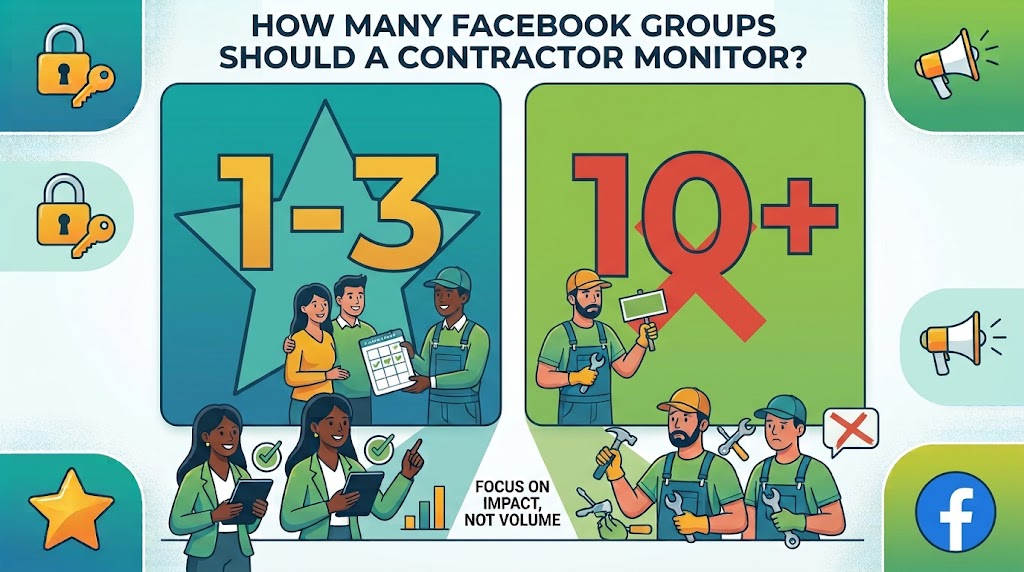
- Contractors do not win Facebook group leads by joining every group in the county. Quality over quantity: a tight list of active, local groups beats a bloated feed you never answer in time.
- Start with 5–10 groups — mixed public and private — that map to towns and subdivisions you already service.
- Expand when those groups book jobs and you have a clear coverage gap. Skip giant statewide spam groups and dead feeds that never produce asks.
- Once the list is right, Facebook group monitoring keeps you early enough to reply — GroupSignal emails the matches so you are not scrolling ten feeds between jobs.
Quality over quantity
The question "how many Facebook groups should I monitor?" sounds like a volume problem. For plumbers, HVAC companies, electricians, and other local trades, it is usually a focus problem. Every group on your list costs attention: join requests, rule-reading, profile credibility, and — most importantly — being early enough on recommendation posts that someone actually messages you.
Fifty half-relevant groups do not produce fifty times the jobs. They produce noise, muted notifications, and late comments. A homeowner who posts "need a plumber in [Town] today" still shortlists from the first useful replies. If you are buried under alerts from towns you do not service, you miss the one thread that mattered. That is why quality over quantity is not a slogan here — it is how the channel works.
Speed still decides a lot of outcomes. Being in the first wave of useful comments matters more than having the longest group list; see why the first 3 comments win the job. More groups only help if you can still show up early where the asks are real.
Think of your group list like truck routes. You would not send a crew to every ZIP code on the map just because the van can drive there. You cover the footprint you can serve well, then add routes when demand proves it. Facebook groups deserve the same discipline.
There is also a reputation cost to sprawl. The more groups you spray with thin, copy-paste replies, the more you look like the spam those groups were built to keep out. A smaller list where you sound local and useful compounds: admins tolerate you, neighbors remember you, and the next ask is easier to win. Quantity without that trust is just unpaid advertising that burns the room.
Start with 5–10 mixed groups
For most contractors, 5–10 groups is the right starting band. That is enough to cover a realistic metro or multi-town service area without turning monitoring into a second full-time job. It is also the range where manual scrolling starts to fail and continuous alerts start to pay for themselves.
Mix privacy types on purpose:
- Public town / recommends groups — easier to join, good breadth, useful while private memberships are pending.
- Private neighborhood / HOA / subdivision groups — often higher trust and cleaner "who do you use?" threads, with fewer out-of-area contractor pile-ons.
Private vs public is not either/or. A practical mix — roughly half and half when you can get approved — usually outperforms an all-public sprint. For why private rooms often convert better and how access actually works, read private vs public Facebook groups for leads.
What belongs on that starter list:
- Neighborhood / Neighbors groups for towns you roll trucks to
- Local recommends or tip groups built for hiring asks
- HOA or subdivision private groups in your densest routes
- Occasionally a quiet buy/sell group if service asks show up there
What does not: giant statewide "home pros" spam groups, contractor-only networking rooms, hiring boards for techs looking for work, and inactive groups that have not seen a real recommendation post in months. If you want the broader method stack — which groups, how to reply, when monitoring beats scrolling — see how to get leads from Facebook groups.
Start with the groups that match where your trucks already go.
Start watching your groupsMap groups to your service area
Before you chase a bigger number, write down the map. List every city, suburb, and subdivision you actually service — not the ones you might take "if the job is big enough." Then find one or two strong groups per cluster. The goal is coverage without duplicates: three overlapping city groups that post the same asks are not three times the opportunity.
A simple mapping pass looks like this:
- Core towns: 1–2 active public groups each (neighbors + recommends if both exist).
- Dense subdivisions: private HOA / neighborhood groups where you already win word-of-mouth.
- Edge towns:only if you regularly take jobs there; skip "someday" markets.
Trade-specific playbooks use the same geography logic with different post language. Plumbers watch leaks and water heaters; Facebook group leads for plumbers walks that list. HVAC shops live on no-cool / no-heat timing — see Facebook group leads for HVAC. Electricians prioritize breakers, panels, and EV asks — Facebook group leads for electricians. In every case, the group count follows the map, not the other way around.
Also match your profile to the footprint. Neighborhood groups expect a local-looking personal profile with company name, trade, and towns in the intro. A vague out-of-area identity gets ignored even when you reply first. Mapping groups without looking local wastes the list.
Revisit the map quarterly. Service areas drift — you drop a far town, add a new subdivision, or start taking more commercial work. Your group list should follow the trucks, not last year's ambition. Five strong groups in today's real footprint beat fifteen leftovers from a growth spurt you never staffed.
When to expand
Expand when the current list is working — not when you feel anxious that a competitor might be in one more group. Concrete signals that it is time to add coverage:
- You are booking jobs from the groups you already watch, and reply quality is consistent.
- Alerts are manageable. You are not drowning in irrelevant posts or ignoring the inbox.
- A town or subdivision you service has clear demand and zero coverage on your list.
- A private group you requested finally approved you — add it; that is earned coverage, not random volume.
- You keep hearing "someone in [neighborhood group] recommended a different company" from customers in streets you already drive.
When you expand, add in small batches — two or three groups at a time — and watch conversion for a couple of weeks. If the new rooms produce noise without estimates, prune them. Growth should look like a better map, not a higher unread count.
Seasonal demand can justify temporary expansion too. HVAC shops often add coverage before peak summer and winter; plumbers before freeze season; roofers after storms. Just treat those adds as experiments with an end date. If the group stays quiet after the rush, drop it instead of carrying dead weight all year.
Plan tiers exist for a reason. GroupSignal plans are $79, $139, and $199 a month by how many groups you need watched. Use the tier that matches a list you can actually work, then step up when the map justifies it — not because empty slots feel wasteful.
When more groups hurts
More groups hurt when they dilute speed. If every alert competes with ten low-intent posts, you stop treating matches like inbound calls. Late replies feel inevitable; then the channel looks "dead" when the real issue was list quality.
Warning signs your list is too fat:
- You routinely see matches hours after they posted.
- Half the alerts are DIY debates, hiring posts, or wrong towns.
- You mute notifications because the noise is constant.
- Admins are warning you — or removing you — for spray-and-pray replies.
- You cannot name which three groups booked work last month.
Prune ruthlessly. Keep groups that produce conversations and estimates. Drop inactive rooms, duplicate coverage, and anything outside your real service area. A lean list you answer in the first hour beats a bloated list you skim after dinner.
Manual checking makes the fat-list problem worse. One quiet group is manageable by hand. Five to ten across a workday is where scrolling becomes a lottery — especially on private groups you forget exist. That is the practical ceiling where continuous monitoring stops being optional if Facebook is a real lead channel for you.
Shared inboxes help, but they do not fix a bad list. If three people on your team are racing through irrelevant alerts, you still burn time. Clean the map first, then decide who owns the first reply when a real match hits. Process amplifies a good list; it cannot rescue a noisy one.
Let monitoring cover the list
Getting the number right is half the job. The other half is seeing posts while the thread is still open. A short, high-quality list still fails if nobody is watching it during jobs.
Facebook group monitoring is how contractors keep 5–10 (or later 15+) groups covered without living in the app. GroupSignal watches public and private groups on a continuous schedule and emails you when a post matches your trade and towns. Plans run $79–$199/mo by group count. We do not auto-comment or message homeowners for you — you get the alert and reply as the local business. Start watching your groups once your map is set, so quality over quantity still wins on timing.
The workflow is simple: pick the right 5–10, keep them mapped to where you work, prune what does not book, and let alerts handle the watch. That is how contractors turn Facebook groups into a reliable lead channel instead of another feed they feel guilty about ignoring.
Watch the right 5–10 groups continuously — not fifty you never answer.
Start watching your groupsFAQ
How many Facebook groups should a contractor monitor?
Most home service shops do best starting with 5–10 active neighborhood and recommends groups that cover towns they actually service. Expand only after those convert; more groups is not automatically more jobs.
Should I monitor only public Facebook groups?
No. A mix of public town groups and private neighborhood/HOA groups usually works better. Public for breadth, private for higher-trust asks — same footprint you already drive.
When should I add more Facebook groups?
When your current list books jobs consistently, alerts feel manageable, and you have a town or subdivision with demand you are not covering yet. Do not expand just because a plan allows more slots.
Can I monitor Facebook groups by hand?
One or two quiet groups, maybe. Five to ten across multiple towns while you are on jobs is where manual scrolling fails — that is when continuous alerts matter more than checking feeds at lunch.
Does GroupSignal comment in groups for me?
No. We email you when a matching post appears. You reply yourself. We don't auto-comment or message homeowners on your behalf. Plans are $79, $139, and $199 a month by group count.
Ready to stop scrolling groups yourself?
Start watching your groups