TL;DR
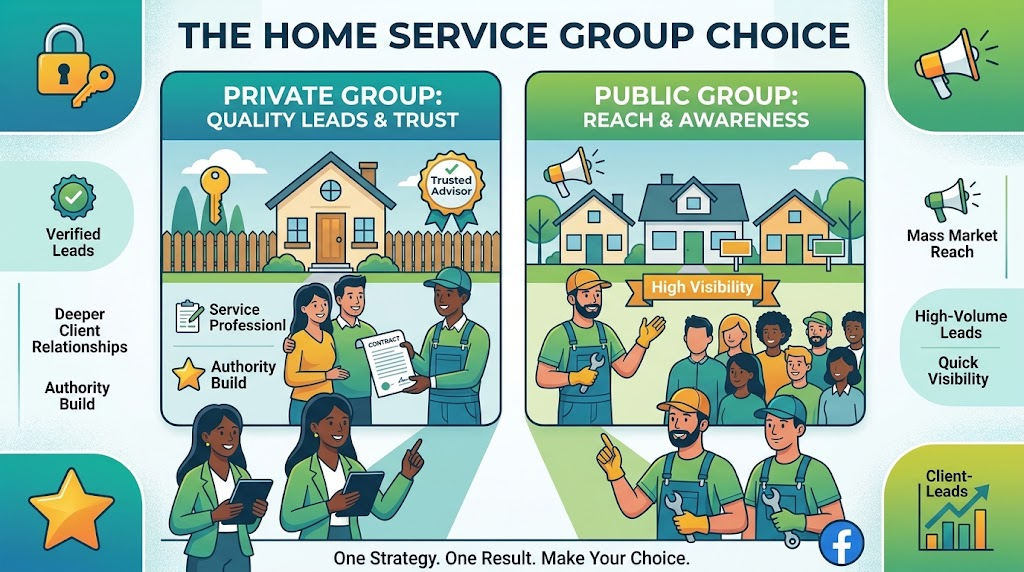
- For plumbers, HVAC companies, and electricians, private neighborhood Facebook groups often convert better than big public ones — fewer spam replies, more neighbor trust, and asks that already sound ready to hire.
- Access is membership-based. You (or a monitoring service with legitimate access) must be approved into the group. There is no clean workaround that skips Facebook's rules.
- Public groups are easier to discover and monitor; private groups take setup first, then the same continuous watch and email alerts.
- Cover both. Use public groups for breadth and private ones for higher-trust local asks — and let GroupSignal email you matches so you can reply while the thread is still open.
Why private groups often convert better
Homeowners hire from people they trust. A private neighborhood or HOA Facebook group is already a trust filter: members were approved, admins kick obvious spam, and the feed feels like neighbors talking — not a billboard. When someone posts "does anyone know a good plumber near [subdivision]?" the ask is social proof in motion. Your reply sits next to real neighbor names, not a pile of out-of-area contractor accounts.
That changes conversion. In noisy public groups, the homeowner often gets ten nearly identical pitches and goes quiet. In a quieter private group, three useful replies can be the whole shortlist. Being early still matters — see why the first 3 comments win the job — but early and inside a high-trust room beats early in a spammy free-for-all.
Private groups also tend to concentrate geography. A subdivision group maps to streets you actually drive. A statewide "Home Pros Recommend" public group mixes towns you will never service with DIY debates and hiring posts. Tighter geography means fewer false alarms and more jobs you can actually book.
Admins keep many of the best local groups private on purpose: to keep solicitation down. Paradoxically, that is why they are valuable. Fewer competitors watch them daily. The posts still happen — water heaters, no-cool nights, tripped breakers — they just do not sit on an open search page for every marketer in the county.
There is also a soft reputation effect. In a private neighborhood group, people remember who was helpful last month. A calm, useful reply on a non-emergency thread can turn into a DM weeks later when the AC dies. Public mega-groups rarely reward that kind of continuity — the crowd is too big and too transient.
Where public groups still win
Public does not mean useless. Town-wide recommends groups, local tip groups, and active "neighbors of [city]" publics can produce steady volume. They are easier to find, easier to join, and easier to add to a monitoring list on day one. For a shop expanding into a new town, public groups are often the first coverage layer while private memberships are still pending.
The tradeoff is noise and competition. Public threads attract more contractors, more copy-paste replies, and more admin crackdowns after spam waves. You can still win — especially if you reply like a helpful local instead of a flyer — but expect a lower hit rate per post than a well-run private neighborhood group.
Treat public groups as top-of-funnel awareness and private groups as higher-intent local demand. The method stack (which groups, how to reply, when monitoring beats scrolling) is the same either way; see how to get leads from Facebook groups.
Watch the private neighborhood groups your trucks already drive through.
Start watching your groupsAccess and membership reality
Private means private. You cannot scrape, sneak, or "just monitor" a closed group without approved membership. Admins ask screening questions for a reason. Answer them honestly: you live or work locally, you will follow the rules, you are not there to dump weekly promo posts. Getting declined once and creating throwaway accounts to force your way in is how you burn the channel for your whole company — and how you get the whole trade labeled as spammy in that neighborhood.
Same standard applies to tools. A legitimate Facebook group monitoring service covers private groups only when access is legitimate — you are already a member and connect access properly, or the service handles membership on its side within Facebook's rules. There is no product feature that magically reads private groups you have never been allowed into. If a pitch sounds like a bypass, treat it as a red flag.
Expect some friction. Approvals can take hours or days. Some admins want proof you live in the subdivision; others allow local businesses if you stay useful. That friction is the point of the group. It is also why the leads that do appear are often worth more than a cold public thread with twenty contractor comments.
Practical checklist when you request to join:
- Use a personal profile that looks local, not a brand-new Page-only identity.
- Read the rules before your first reply. Many private groups ban hard promo and phone-number spam.
- Contribute like a neighbor sometimes — not every comment has to be a pitch.
- If you are denied, respect it. Find another subdivision or recommends group in the same service area.
How monitoring differs
From a contractor's seat, public and private monitoring feel similar once they are running: something watches the group, matches posts to your trade and towns, and emails you. The difference is mostly setup and reach.
Public groups
Usually add by name or link. No membership maze. Good for spinning up coverage fast across several towns. Continuous checks still matter — public recommendation posts move just as quickly as private ones once they hit the feed.
Private groups
Membership or equivalent access comes first. After that, the watch schedule should be the same: continuous, not a once-a-day digest you open after dinner. Private posts are not slower just because the group is closed; a burst pipe at 10am still awards the first useful replies.
What stays the same
Keyword and intent thinking still applies — recommend, looking for, need, plus your service language and towns. If you want the setup detail, read how to monitor Facebook groups for keywords. And whether the group is public or private, the alert should land in your inbox so you reply. Auto-commenting is not how GroupSignal works, and it is a fast way to look like spam in a private neighborhood group that exists specifically to keep spam out.
One more operational difference: private groups are easier to "forget." You joined six months ago, the app stopped surfacing them, and you only rediscover a hiring post when a neighbor texts you that someone else already got the job. Continuous monitoring closes that gap the same way it does for public groups — except the opportunity cost is often higher because those private threads convert when you do show up.
What this looks like by trade
Plumbers
Private subdivision groups shine for active leaks, water heaters, and "who do you use?" threads where neighbors already trust each other. Public city groups still catch overflow demand during freezes and storms. Pair both, and reply early with town coverage and a clear next step. Full playbook: Facebook group leads for plumbers.
HVAC
No-cool and no-heat posts in private neighborhood groups are pure speed contests with less contractor pile-on than big public feeds. Public recommends groups help in shoulder seasons when people plan maintenance. Details: Facebook group leads for HVAC.
Electricians
Panel upgrades, EV chargers, and "breaker keeps tripping" asks show up in both — but private HOA and neighborhood groups often mean the homeowner wants a licensed local, not the cheapest commenter in a statewide thread. More: Facebook group leads for electricians.
A practical public + private mix
- Map towns first. List every city and subdivision you actually roll trucks to.
- Add 3–5 public groups that cover those towns for immediate breadth.
- Request 3–5 private neighborhood / HOA groups in the same footprint. Wait for approval; do not force it.
- Monitor all of them continuously. Manual scrolling fails hardest on private groups you forget exist.
- Track which privacy type books jobs. Double down where estimates come from; prune dead weight monthly.
You do not need fifty groups. You need the right ten — mixed public and private — watched when you cannot watch them yourself.
If you're comparing tools after you settle on that public + private mix, see our Groups Watcher alternative.
Let alerts cover both
Private vs public is not an either/or brand decision. It is an operations decision: cover the rooms where homeowners already ask, respect how you get in, and answer while the thread is live.
GroupSignal monitors public and private Facebook groups on a continuous schedule and emails you when a post matches your trade and service area. Plans are $79, $139, and $199 a month by group count. We do not auto-comment or message homeowners for you — you get the alert and reply as the local business. Start watching your groups if you want private neighborhood coverage and public town groups in the same inbox.
Get email alerts from the public and private groups that actually book jobs.
Start watching your groupsFAQ
Do private Facebook groups produce better home service leads than public ones?
Often yes for local trades. Private neighborhood and HOA groups tend to have fewer spammy contractors, higher trust, and more genuine 'who do you use?' posts — so replies convert more often when you catch them early.
Can I monitor a private Facebook group without being a member?
Not in any legitimate way. Private groups require approved membership. GroupSignal covers private groups when access is set up properly — through membership you already have, or access handled on our side — not by bypassing Facebook's rules.
Should I abandon public Facebook groups for leads?
No. Public groups can still produce volume, especially town-wide recommends and tip groups. The better play is covering both: public for breadth, private neighborhood groups for higher-trust asks.
How is monitoring different for public vs private groups?
Public groups are simpler to add by name or link. Private groups need membership/access first, then the same continuous checking and email alerts. Either way, GroupSignal alerts you — it doesn't auto-comment for you.
What does GroupSignal cost for watching public and private groups?
Plans are $79, $139, and $199 a month depending on how many groups you need watched. Public and private coverage is part of the product; you're paying for continuous checks and email alerts, not for auto-posting.
Ready to stop scrolling groups yourself?
Start watching your groups